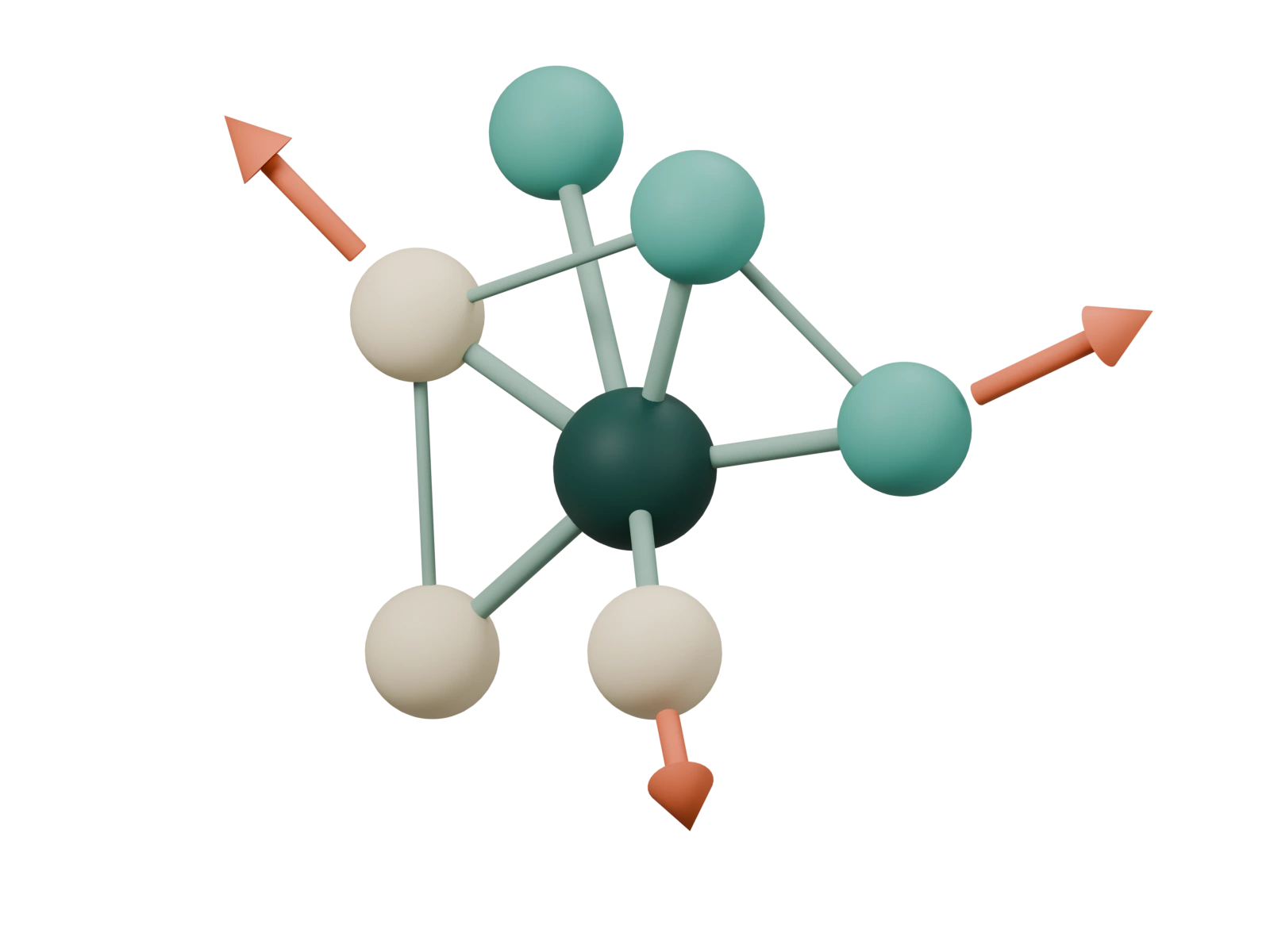
Machine-learning potentials must capture the symmetries and chemical diversity of atomic interactions while remaining efficient enough for useful simulations. We develop representations and architectures that address this balance, from mathematical tensor operations to trainable models and reusable computational tools.
Cartesian Tensor Representations
Atomic coordinates and many physical observables are naturally expressed in Cartesian form. Our Cartesian-3j work develops tensor-coupling tools for irreducible Cartesian representations and examines how the choice of tensor basis affects equivariant interatomic models. The associated cartnn implementation provides a research reference for exploring these constructions.
TACE and Edge Cluster Expansion
The TACE family connects equivariant tensor representations with flexible atomistic modeling. Our research develops Cartesian tensor operations, universal embeddings and efficient ways to represent many-body interactions. TECE explores an edge cluster expansion with radial rotary attention. Together, these approaches support the development of accurate, efficient and transferable interatomic models.
Local O(2), Reflection and Time Reversal
Efficient local-frame computation must preserve the transformation rules of the physical quantities being modeled. Our local O(2) framework explicitly incorporates reflections as well as rotations, enabling spatial-parity-complete equivariant learning. Time-reversal labels extend this treatment to magnetic quantities. EquivariantX provides composable operators, and magnetic TACE (mTACE) demonstrates the framework on magnetic atomistic models. The work also develops Wigner-6j recoupling to reuse intermediate information across neighboring interactions.
Toward Reactive Foundation Models
We are working toward transferable models that connect broad chemical coverage with reliable descriptions of reactivity and additional physical degrees of freedom. This direction brings together data generation, equivariant architectures and computational efficiency. The extent of applicability must be assessed for each released model and its training domain.